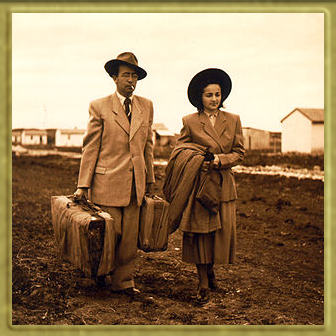
The Great Aliyah. Eine schöne Online-Exhibition der Central Zionist Archives [hebräisch, aber die Fotos sprechen auch so.]
Tägliche Presseschau, linksliberal bis links: www.pickings.de.
url.antville: 17 tage online, gutes weblog, vor allem film.
Meine Genealogie deponiert. Blogtree ist eine Art Standesamt für Weblogs. Das Schöne ist: Man kann sich seine Eltern selbst aussuchen. Das Schöne ist: Auch mehr als zwei. Nicht so schön ist: Wenn die Eltern schon verstorben und irgendwo im digitalen Nichts verdunstet sind, bleiben sie verschwiegen. Das Schöne ist: Beim Elternadoptieren erinnert man sich daran, wie es war, damals in der Kindheit, vor zwei Jahren. Diese Faszination, die von der Euroranch und von Langreiter ausging. Diese Coolness bei Netdyslexia. Diese Freundlichkeit von Ronsens. Dieses Glücksgefühl gleich nach der Geburt Maloramas. Diese Bewunderung für Textism und ft.train. Immer wieder neue Eltern, obwohl ich schon längst im Krabbelalter war. Das Schöne ist: das Totengedenken für die verlorengegangenen Eltern. blackandwhiteandblue und nightcat, aber das ist eine andere Geschichte, und diese Mom lebt ja noch, ein anderes Leben. Das Schöne ist: Die Geschwister, die man plötzlich kennenlernt, noch nie gesehen, und es ist, als würde man sich schon ewig kennen. Fidelité: Color sonnets, was für eine wunderbare Idee. Das slower.net, wie das rockt. Die Lost Pages, Flann O´Brien, drunken confidence & phonetics. Das Schöne ist: Die Geschwister, die man nun hat, haben ihrerseits Geschwister. Quarlo, unfassbar gute Fotos aus New York. Bluhisorange, und daraus nur ein Zitat:
in the morning, as i stare at my red eyes in the bathroom mirror, i decide that my toothbrush is the most solid thing in existence. my toothbrush is exactly where i left it last. it's the same color and the same shape it was yesterday. its handle feels far more real than the rug i tripped over in the middle of the night, its bristles firmer than the crumple of used tissues on the floor. the toothpaste tastes the same as always. i clench my teeth as i brush, hard and fast. a spray of saliva and paste hits my reflection in the mirror.Das Verwunderlichste ist: Man hat auch Kinder gezeugt auf dem Weg und kann sich an die Nächte nicht erinnern...
videos.antville.org: links to cool music videos.
The Hannah Arendt Papers at the Library of Congress: Eine beglückend umfangreiche Sammlung von Manuskripten, Vorlesungskonvoluten, Korrespondenzen, Notizen, Papieren usw. Unaufhörlich macht man neue Entdeckungen. Alle Fassungen von Eichmann in Jerusalem, Interviews in deutschen Rundfunkanstalten, Vorlesungen über Kant, Marx, Zionismus, Augustinus, den deutschen Antisemitismus, gänzlich Unerwartetes wie ein Text über Kybernetik, eine Kindergeschichte oder Gedichte, wie dieses hier aus dem Jahr 1943:
Aufgestiegen aus dem stehenden Teich der Vergangenheit Sind der Erinn´rungen viele. Nebelgestalten ziehen die sehnsüchtigen Kreise meiner Gefangenheit Vergangen, verlockend, am Ziele.Das einzige Problem: Es handelt sich um Scans der Originaldokumente, die Lektüre ist also ein wenig mühsam. Der Allgemeinheit zugänglich ist alles mit dem Vermerk "images display offsite".Tote, was wollt ihr? Habt Ihr im Orkus nicht Heimat und Stätte? Endlich den Frieden der Tiefe? Wasser und Erde, Feuer und Luft sind Euch ergeben, als hätte Mächtig ein Gott Euch. Und riefe
Euch aus stehenden Wässern, aus Sümpfen, Mooren und Teichen Sammelnd geeinigt herbei. Schimmernd im Zwielicht bedeckt Ihr mit Nebel der Lebenden Reiche, Spottend des dunklen Vorbei.
Spielen wollen auch wir; ergreifen und lachen und haschen Träume vergangener Zeit. Müde wurden auch wir der Strassen, der Städte, des raschen Wechsels der Einsamkeit.
Unter die rudernden Boote mit liebenden Paaren geschmückt auf Stehenden Teichen im Wald Könnten auch wir uns mischen - leise, versteckt und entrückt auf Nebelwolken, die bald
Sachte die Erde bekleiden, das Ufer, den Busch und den Baum Wartend des kommenden Sturms. Wartend des aus dem Nebel, aus Luftschloss, Narrheit und Traum Steigenden wirbelnden Sturms.
Eine schöne Rede, 1986 von einem gewissen Richard Mitchell, Underground Grammarian, gehalten:
I think of writing as being, if anything, against my life. And then it occurred to me that maybe that’s not so bad, and if I were to suggest writing to another human being—a very bad act, I think—but if I were to suggest it to another human being, I would suggest it because that human being needs something against his life, something to change it in some drastic way, by which I would mean, his life was not in good condition, and he had damn well better write, to destroy it. And it is with that in mind that I speak.
You are writers, or would-be writers. I would remind you first of this: I do know that in some cities, there is a shortage of taxicabs. And in some cities in America there is a shortage of men’s rooms; this is probably true of women’s rooms, too, but I don’t notice that shortage. I can think of numerous things of which there is a shortage. Of writers, there is no shortage. I do not hear people going around in the streets, saying, "You know what we need in this country’s more writers!"
We live in a time when writing—writing has become too common, too widespread among us. I expect any day to meet a man at a cocktail party and ask him what he does and he says, "I’m a writer," and I ask him, "Oh, what have you written?" and he answers, "Close cover before striking."
Or "HOT." "HOT." I know the man who wrote "HOT," I wonder if he’s the same man who wrote "COLD." Or a man who takes his brushes and paints on a door, "MEN." A writer? Yes! We have people who write in manuals, people who write instructions, people who write speeches for other people to deliver, people who write wheedling, conniving invitations to us to spend money for one thing or another—people who write their initials on the oak tree, I suppose. We have to start understanding this business of "writer."
You remember Graham Greene’s novel A Burnt-Out Case? That was about a novelist who had run out his string, and I think it was Cromelin who wrote a spoof of it in The New Yorker called "A Burnt-Out Ace," and that was about a man who went around to cocktail parties brooding, and introducing himself as a disappointed writer, and it turned out he was a sky-writer; he wrote "Pepsi-Cola" as one of his very, uh, great works.
Now, if you take up writing seriously, I can’t promise this, but I can hope this: I hope that it will make you profoundly unhappy. I hope that every day will bring you some bad news from the frontier of that unknown territory in which you work. I hope every day you rise up from your desk and say, "God, what a fool I was yesterday!" So that you can say that again tomorrow. And thus write against your life.
There was a very popular whoring book around lately—I don’t know, it hasn’t been for some time, I can’t remember when, it was called "I’m Okay"—uh, something—"I’m Okay, You’re Okay." Oh, what pleasant news. Believe me, you’ll never lose money by telling people how nice they are. You’ll never lose money by telling people, "Hey! Don’t worry about your miserable rotten behavior and your perversions, and your lies, and your thefts! You’re okay!" No one will blame you for this, and you may actually do quite well. I don’t know about you—I suspect, but I don’t know about you—however I will tell you this: I am not okay. I am not okay. I do not carefully define my terms when I think. I do not test, rigidly, as though I were a stranger, every one of my quaint and curious notions, prejudices, and beliefs, I do not do this, I am not okay. I lie. Whether I lie to you is none of your damn business; I lie to me, as to what I am and how it is in me. And I am not okay. (And I don’t think you’re okay either, but all I can do is suspect that.)
I will tell you this—and I will tell you this as a command, because you can walk out now before you hear this command, but I’m going to give you this command:
Don’t—shine.
Don’t seek to shine.
Burn.

"We're asked not to fornicate."
[NYT: It´s Never Too Late to Be a Virgin, Registrierung erforderlich]
Nächste Seite