lass dich umarmen!
Als sie sich im Bett räkelte, wachte Haku halb auf und murrte: "Hatte ich einen eigenartigen Traum!" Mayuko wußte: Erzählt er mir jetzt zuerst seinen Traum, geht mein eigener Traum unweigerlich verloren. [Minako Obe, Träume fischen]
Der Schauspieler ahmt sinnlos den Menschen nach, er differenziert im Ausdruck und zerrt eine andere Person dabei aus seinem Mund hervor, die ein Schicksal hat, welches ausgebreitet wird. Ich will keine fremden Leute vor den Zuschauern zum Leben erwecken. Ich weiß auch nicht, aber ich will keinen sakralen Geschmack von göttlichem zum Leben Erwecken auf der Bühne haben. Ich will kein Theater. Vielleicht will ich einmal nur Tätigkeiten ausstellen, die man ausüben kann, um etwas darzustellen, aber ohne höheren Sinn. Die Schauspieler sollen sagen, was sonst kein Mensch sagt, denn es ist ja nicht Leben. Sie sollen Arbeit zeigen. Sie sollen sagen, was los ist, aber niemals soll von ihnen behauptet werden können, in ihnen gehe etwas ganz anderes vor, das man indirekt von ihrem Gesicht und ihrem Körper ablesen könne. Zivilisten sollen etwas auf einer Bühne sprechen! Vielleicht eine Modeschau, bei der die Frauen in ihren Kleidern Sätze sprechen. Ich möchte seicht sein! [Elfriede Jelinek, , Theater Heute Jahrbuch 1983]
The hippie’s dissatisfaction, his dissociation from the old stereotypes, has resulted in his fabrication and adoption of new ones. Hip life creates and consumes new roles — guru, craftsman, rock star; new abstract values — universal love, naturalness, openness; and new mystifications for consolation — pacifism, Buddhism, astrology, the cultural debris of the past put back on the counter for consumption. The fragmentary innovations that the hippie did make — and lived as if they were total — have only given new life to the spectacle. . . .
Records, posters, bellbottoms: a few commodities make you hip. When “hip capitalism” is blamed for “ripping off our culture” it is forgotten that the early cultural heroes (Leary, Ginsberg, Watts, etc.) promoted the new lifestyle in the emporium of cultural consumption. These advertising men for a new style, by combining their own cultural fetishism with the false promise of an authentic life, engendered a quasi-messianic attachment to the cause. They “turned on” youth simultaneously to a new family of values and a corresponding family of goods. . . . The difference between the “real” and the “plastic” hippie is that the former has deeper illusions; he acquired his mystifications in their pure, organic form, while the latter buys them packaged: astrology in a poster, natural freedom in his bellbottoms, Taoism from the Beatles. While the real hippie may have read and helped develop hip ideology, the plastic hippie buys commodities that embody that ideology. . . [Kenn Knabb / Bureau of Public Secrets, On the Poverty of Hip Life]
Die "Jugend von heute" - ich bleibe bei meiner Greisen-Terminologie - will nichts. Sie hat verraten, was die gequälte Kreatur am Leben hält: den Traum. Der Verdacht, daß sie mit ihrer Unzufriedenheit durchaus zufrieden sei, liegt nahe. So ist es nämlich nicht, daß die jungen Menschen, die in der Hoffnungslosigkeit unserer Epoche baden, vom Weltuntergang überzeugt wären. Sie wissen so gut wie wir, die Alten, daß es weitergeht, wenn auch auf das Unerfreulichste. [Ich, Hans Habe, ich kann diese Jugend nicht leiden, Twen 5/1961]
Of critics, the one I can least stomach is the thunderstealer who slyly and regularly goes in for the "As someone has aptly remarked" and the "As someone has cleverly observed" stuff. He is the kleptomaniac of criticism, the shoplifter in the literary jewelry store, the left-handed glory grabber. He is a critic in the sense that a phonograph is an opera singer. He is the oyster in the pearl. He borrows the cigar, borrows the tip-clipper, borrows the holder, borrows the match - and then congratulates himself warmly on achieving by himself the climacteric grand spit. [George Jean Nathan, Répétition Générale]
Recalling the minutes after his heart attack in 1973, Birkin noted that "Serge refused the blanket that an ambulance-man placed over his on the stretcher, because the colours clashed. He made them fetch a cashmere rug. He also stuffed a briefcase full of unfiltered Gitanes. He knew he'd have trouble getting them at the hospital."
So sehr mir Heine im Gespräch unter vier Augen gefiel, eben so sehr mißfiel er mir, als wir ein paar Tage später bei Rothschild zu Mittage waren. Man sah wohl daß die Hauswirthe Hein'e fürchteten, und diese Furcht mißbrauchte er um sich bei jeder Gelegenheit verdeckt über sie lustig zu machen. Man muß aber bei Niemand essen, dem man nicht wohlwill, und wenn man Jemand verächtlich findet muß man nicht bei ihm essen. Es setzte sich daher auch von da an unser Verhältniß nicht fort. Unter den Gästen bei Rothschild befand sich auch Rossini. Ich hatte ihn vor Jahren flüchtig in Italien gesehen. Jetzt war er ganz Franzose geworden, sprach die fremde Sprache wie ein Eingeborner und war unerschöpflich an Witz und Einfällen. Seine Feinschmeckerei ist bekannt. Er war, obwohl Hausfreund, dießmal vornemlich geladen um die Proben einer anzukaufenden Partie Champagner zu versuchen, worin er als ein vorzüglicher Kenner galt. Beim Nachhausegehen giengen wir eine Strecke mitsammen. Ich fragte ihn ob das Gerücht wahr sey, daß er für die Krönung des Kaisers von Östreich zum König von Italien eine Oper schreibe. Musikalisch merkwürdig war mir seine Antwort. Wenn man Ihnen jemals sagt, erwiederte er, daß Rossini wieder etwas schreibe, so glauben Sie´s nicht. Erstens habe ich genug geschrieben, dann giebt es Niemand mehr der singen kann. Im Übrigen habe ich in Paris gesehen was Jedermann sieht, es ist daher darüber nichts zu sagen. [Franz Grillparzer, Selbstbiographie]
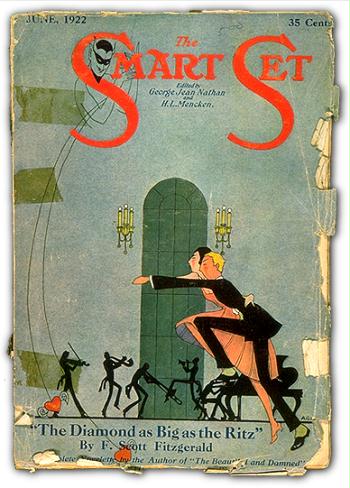
"What a dream it was," Kismine sighed, gazing up at the stars. "How strange it seems to be here with one dress and a penniless fianc_!
"Under the stars," she repeated. "I never noticed the stars before. I always thought of them as great big diamonds that belonged to some one. Now they frighten me. They make me feel that it was all a dream, all my youth."
"It was a dream," said John quietly. "Everybody's youth is a dream, a form of chemical madness."
"How pleasant then to be insane!"
"So I'm told," said John gloomily. "I don't know any longer. At any rate, let us love for a while, for a year or so, you and me. That's a form of divine drunkenness that we can all try. There are only diamonds in the whole world, diamonds and perhaps the shabby gift of disillusion. Well, I have that last and I will make the usual nothing of it." He shivered. "Turn up your coat collar, little girl, the night's full of chill and you'll get pneumonia. His was a great sin who first invented consciousness. Let us lose it for a few hours."
So wrapping himself in his blanket he fell off to sleep.
[F. Scott Fitzgerald, The Diamond as Big as the Ritz.]
Nächste Seite