
“Skin:Surface, Substance + Design” will open at the Smithsonian’s Cooper-Hewitt, National Design Museum on May 7,2002, and continue through September 1 5,2002.“Skin” highlights the responses of designers from around the world to a culture obsessed with physical appearances and transformed by biotechnology. The exhibition focuses on works designed between 1997 and the present and features products, fashion, furniture, architecture and media that are expanding the conventional definition of surface.
Every object has a skin.Thick or thin, smooth or rough,porous or impermeable, skin is the line between a hidden interior and a visible exterior. Reflecting the convergence of natural and artificial life,“Skin ” demonstrates how designers today manipulate the relationship between the inside and outside of objects, garments and buildings to create surfaces that both reveal and conceal:skins that have depth,complexity and their own behaviors and identities.“‘Skin ’ shows the breadth of design thinking today,which encompasses the engineering of new structures as well as the fabrication of seductive forms and metaphors,” Museum Director Paul Warwick Thompson notes.“The exhibition is smart, sexy and provocative.” The rise of digital media over the past decade has changed the practice of design,providing tools for making objects and buildings that resemble living creatures — with complex curves and soft, responsive surfaces —but remain distinctly artificial. “Skin” features the work of such notable designers and architects as Greg Lynn, Petra Blaisse, Morphosis, Ross Lovegrove, Marcel Wanders and many others. The exhibition shows how enhanced and simulated skins are found throughout contemporary life, from clothing, products and buildings to our own living skins.
Informationen: hier
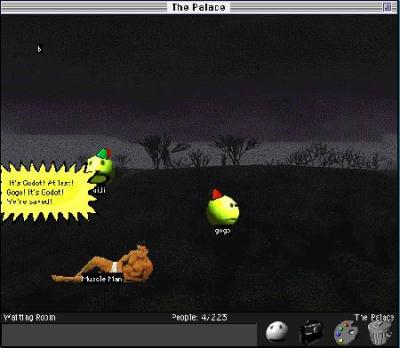
Our first Desktop Theater production was an adaptation and performance of Samuel Beckett's well-known drama "Waiting for Godot" in an internet chat environment.
> Estragon Lower left S/ï-5 Default faceA compression of Guy deBord's Situationist manifesto The Society of the Spectacle performed by and for the spectacled society.Vladimir enters. E: )sigh Nothing to be done. V: )sigh I'm beginning to come round to that opinion. All my life I've tried to put it from me, saying, Vladimir, be reasonable, you haven't tried everything. And I resumed the struggle. So there you are again.
Two Avs whispering over din of Palace goingson Av1: Separation perfected Av2: Illusion only is sacred Av1: Truth profane Av2: Illusion only is sacred Av1: Truth profaneQuicktime Movie der Aufführung: hier
In 1939, Titus visited Europe for five months and attended (without his wife) numerous variety shows featuring contortionist acts. His letters describ-ing these acts are probably the most engaging performance analysis of the halcyon contortionist aesthetic of the 1930s yet available. The Eve Cabaret, the Follies Bergere, and the Casino de Paris in Paris integrated contortionist acts into fantastic narratives featuring monsters, temptresses, and devils. In an Adam and Eve act the performance of voluptuous contortions allowed the sinful couple to recover its “lost” innocence: “He changed his hands to the woman’s knees and she raised her legs, showing the most sensational muscles of her neck and chest lifting the weight of the man” (Dec. 1939). The erotic element in these contortionist performances was glamorously dramatic:
The crudest and most sadistic contortion was one in which the dance[r] was standing up, raised one foot as in [a] frontkick, and the man placed this leg over the woman’s shoulders and forced it down her back, then he raised her in the air handling the other leg and swinging her back and forth. The shape of the contorted leg in her back was something hard to forget. They finished the dance with Magrita in a backbend, her legs wide open in a side-split and the man kissing her in her cachesexe. (Dec. 1939)At the Théâtre de l’Alcazor, all acts were “performed by naked women.” These included trapezists, a lion tamer, acrobats, dancers, magicians, and sing-ers. Titus’s favorite performer was perhaps the Czech contortionist Erni Erikay, whose performance at the Théâtre de l’Alcazor exemplified the trend to situate contortionist acts within extravagantly dramatic contexts. Titus de-scribed her sensational and rather pornographic act with lively affection and in breathlessly convoluted language. The scene was a boudoir containing a polar bear rug upon which she slumbered until strange music awakened her. She wore a transparent black dress, in which she performed several lurid contor-tions. Then she
performed a backbend with her arms tied around the neck, lowering the head till she kissed the bear’s mouth. Suddenly she loosened the pin that fastened her dress in the back, the gown fell to the ground and she ap-peared in her marvelous white nakedness, except the dark spot of her cachesexe. At the sound of the applause, she walked to the front part of the stage and exhibited her body, then she projected her chest, bended backwards, closing more and more the backbend while her arms were handled in snakelike fashion. She bended then her knees and lowering the head she placed the top of the head against the floor and slided her feet farther from her face, she stretched herself at full length. She opened then her legs and when they were in a perfect side-split she raised to normal. After some coiling and bending over the bear’s skin, with the in-tention of exciting the bear to copulate (this was the leitmotiv of the dance) she came to her last posture, something marvelous not only for the difficulty of the trick, but because of the nakedness and beauty of the woman and the way absolutely boneless she handled her body. She per-formed an elbow stand over the bear’s head; first her legs were stretched horizontal over her face, then she folded the legs, projected her chest and bended the body jointing the buttocks to the top of the head, body in zigzag—then lowered the feet, opened the legs making room for the head that was coming through the thighs, and raised the head placing the back of the head against her sex in the closest backbend I have ever seen!The reversal of this position was “so exciting that none was surprised when the bear skin started to move, raised up and walked over the acrobat to copu-late while the curtain was lowered.” In the “second act” of the show, Erikay performed on a “gigantic piano” and walked off the stage “backbended, legs stretched, hands over ankles” (Dec. 1939).
Titus’s enthusiasm for Erikay was such that he made her personal acquain-tance and began to correspond with her. A few months later, he remarked that she had written to him saying that she would send him a new set of pho-tographs “taken especially for me, performing her best contortions and wear-ing her smallest cachesexe” (29 April 1940). But soon he worried that the German occupation of Paris had broken his contact with her: “she must have run away [because she was Czech] so I’m afraid she must have a hard time with the Germans” (10 Dec. 1940). Nearly a year after his request, however, Titus reported that Erikay had sent him 20 photographs of herself, “mostly in the nude” (17 July 1941). But it is not clear from the correspondence how long he maintained his contact with her.
Aus Karl Toepfers faszinierendem Essay: Twisted Bodies. Aspects of Female Contortionism in the Letters of a Connoisseur